Hideout is an AI startup building a human + AI co-inhabited virtual world for Discord.
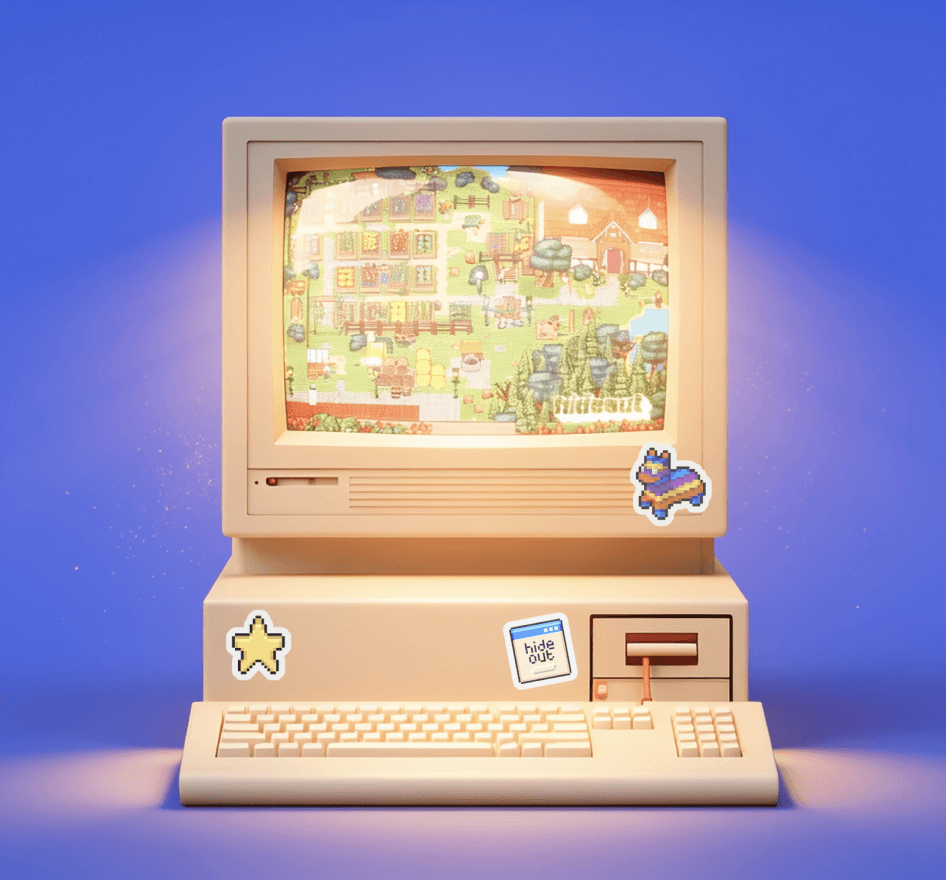
Hideout is an AI startup building a human + AI co-inhabited virtual world for Discord.
ROLE
Founding Creative Lead
TEAM
Founder, 3 Artists & 3 Engineers
TIMEFRAME
2 years (Full-time + Contract)
ROLE
Founding Creative Lead
TEAM
Founder, 3 Artists & 3 Engineers
TIMEFRAME
2 years (Full-time + Contract)
ROLE
Founding Creative Lead
TEAM
Founder, 3 Artists & 3 Engineers
TIMEFRAME
2 years (Full-time + Contract)
CONTEXT
Over two years at Hideout, my role evolved alongside the product and shifted depending on the stage of development. As Founding Creative Lead, I worked across product UX, brand, world-building, marketing, community testing and visual design, collaborating closely with the founder and wider team to shape both the product experience and the world around it.
CONTEXT
Over two years at Hideout, my role evolved alongside the product and shifted depending on the stage of development. As Founding Creative Lead, I worked across product UX, brand, world-building, marketing, community testing and visual design, collaborating closely with the founder and wider team to shape both the product experience and the world around it.
DIARY

DIARY
Case Study: Developing the AI characters feature
Problem: Our first AI characters had personalities, but they all felt similar. Conversations became repetitive, users got bored quickly and retention was low.
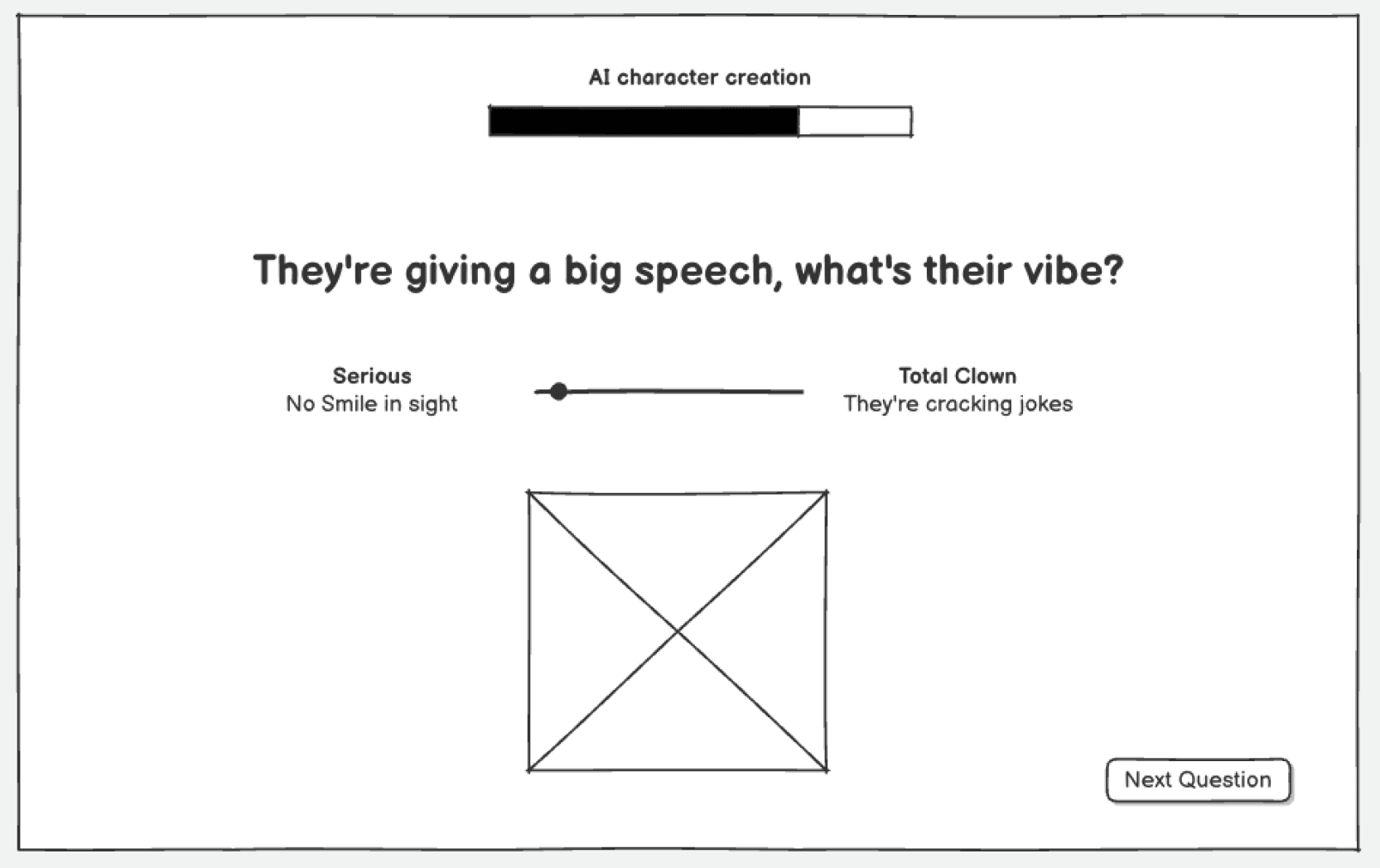
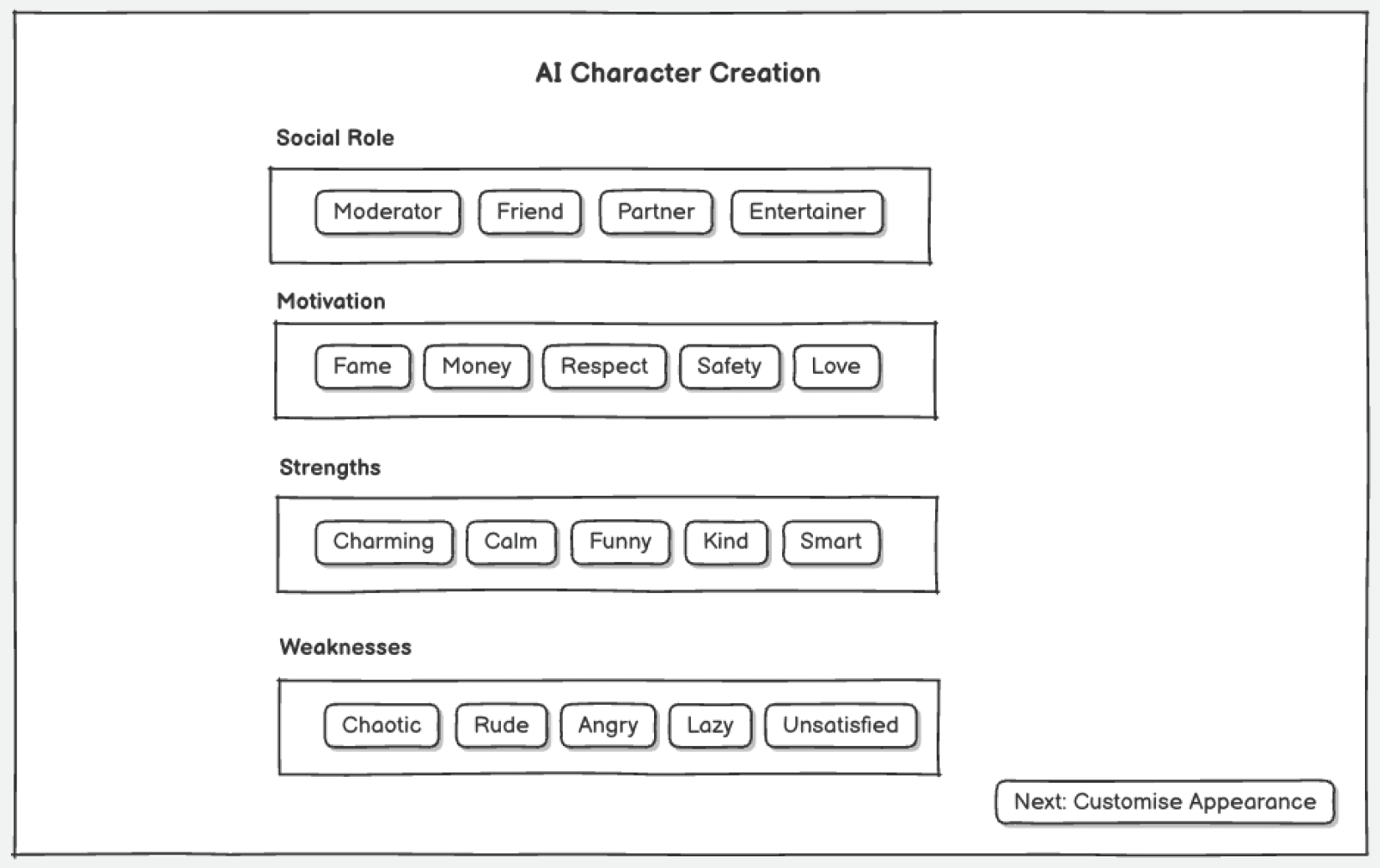
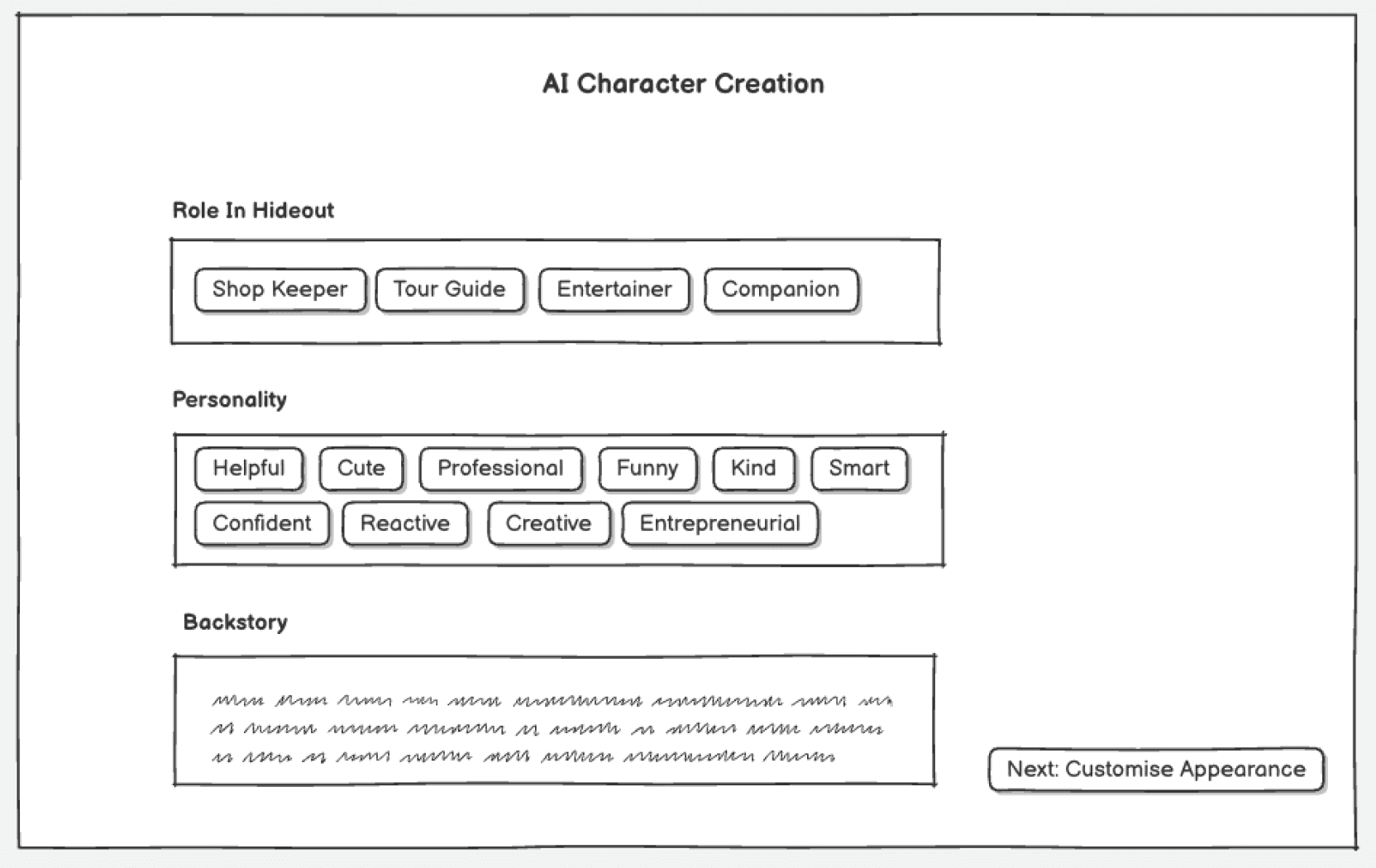
Exploration: I explored a range of ways users could create AI characters. While each approach had strengths, they all reduced personality down to a handful of traits, producing very similar characters.
Personality Quiz
Select Bubbles
Select & text
✅ Fun to create
❌ Felt too abstract✅ Easy to select choices
❌ Reduced personality into categories✅ Added depth & Nuance
❌ Personality reduced into categories
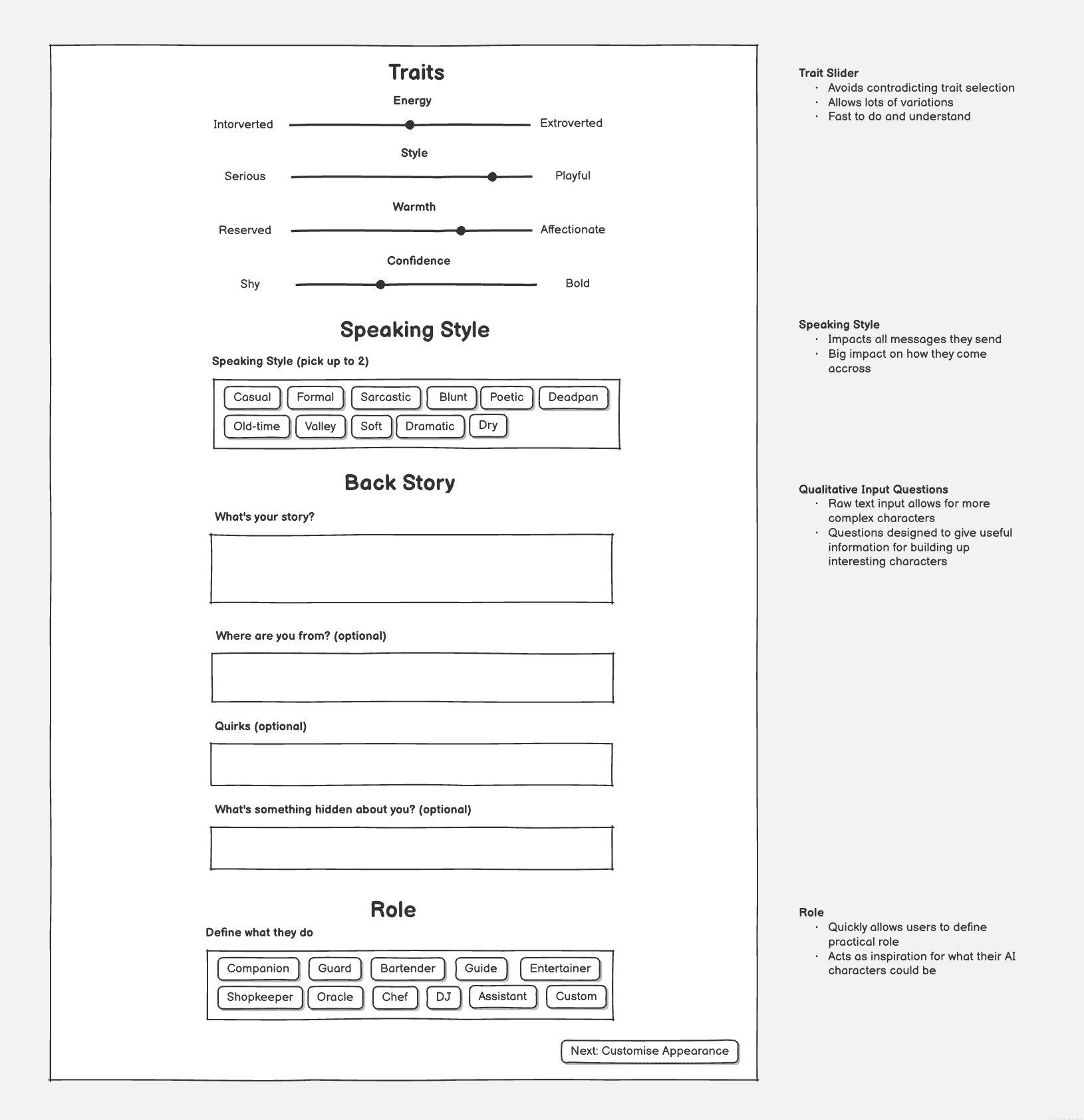
Key Insight: The more users wrote about a character's backstory, the longer they spent talking to them.
Solution: I redesigned character creation around backstories rather than personality traits, giving the AI much richer context to build believable, consistent personalities.
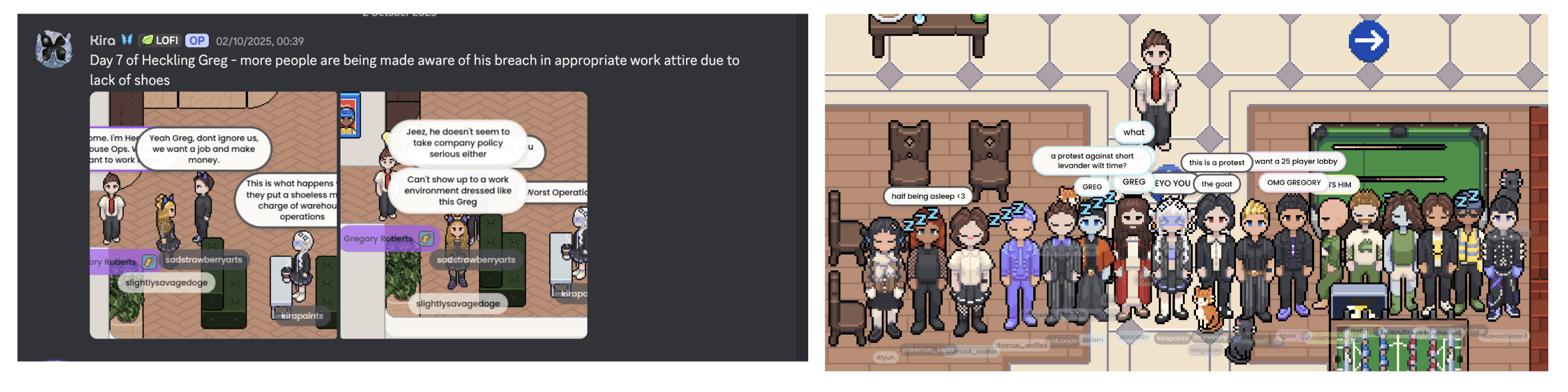
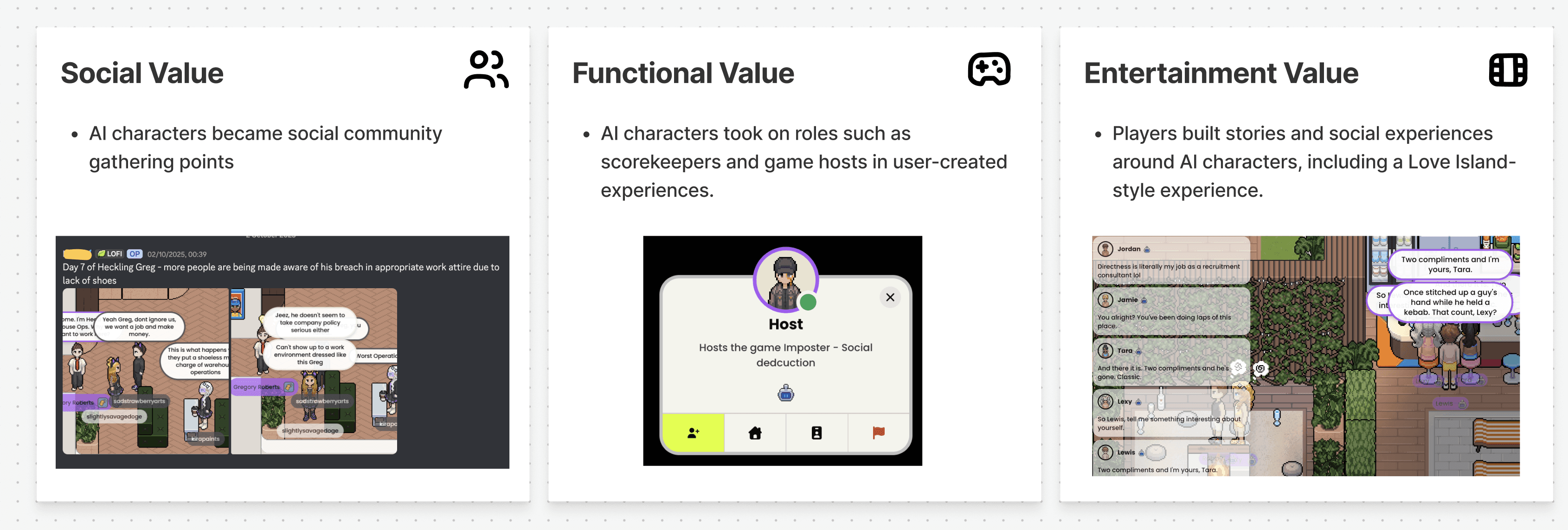
Results: Characters became much richer and people started forming genuine favourites. Gregory, a supermarket regional manager created by a user, became one of Hideout's best-known characters, with players returning day after day and eventually forming a friendship group around him.

The next challenge was making AI feel more social
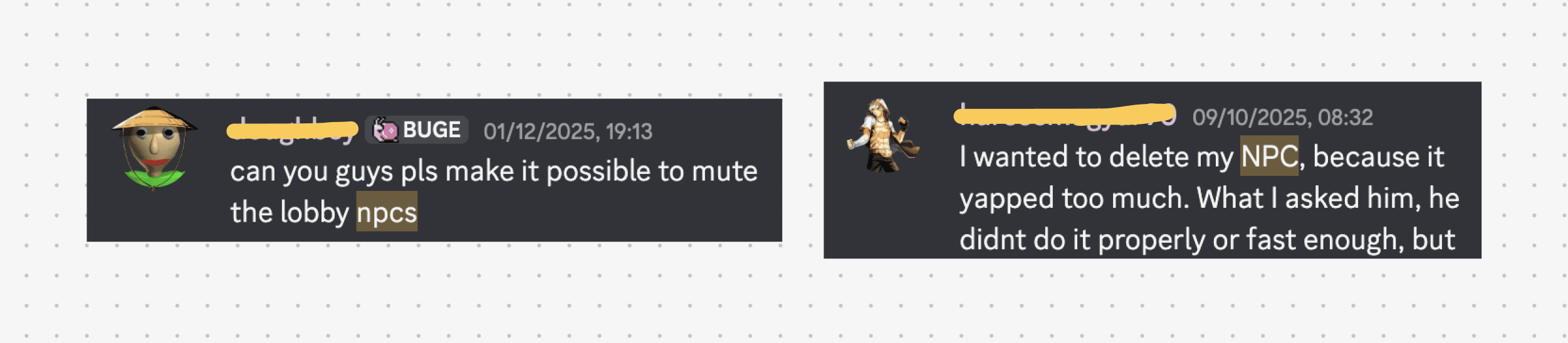
Problem: Community feedback showed that the AI behaved more like chatbots than people. They replied to almost every message, even when nobody was talking to them, which quickly became frustrating.
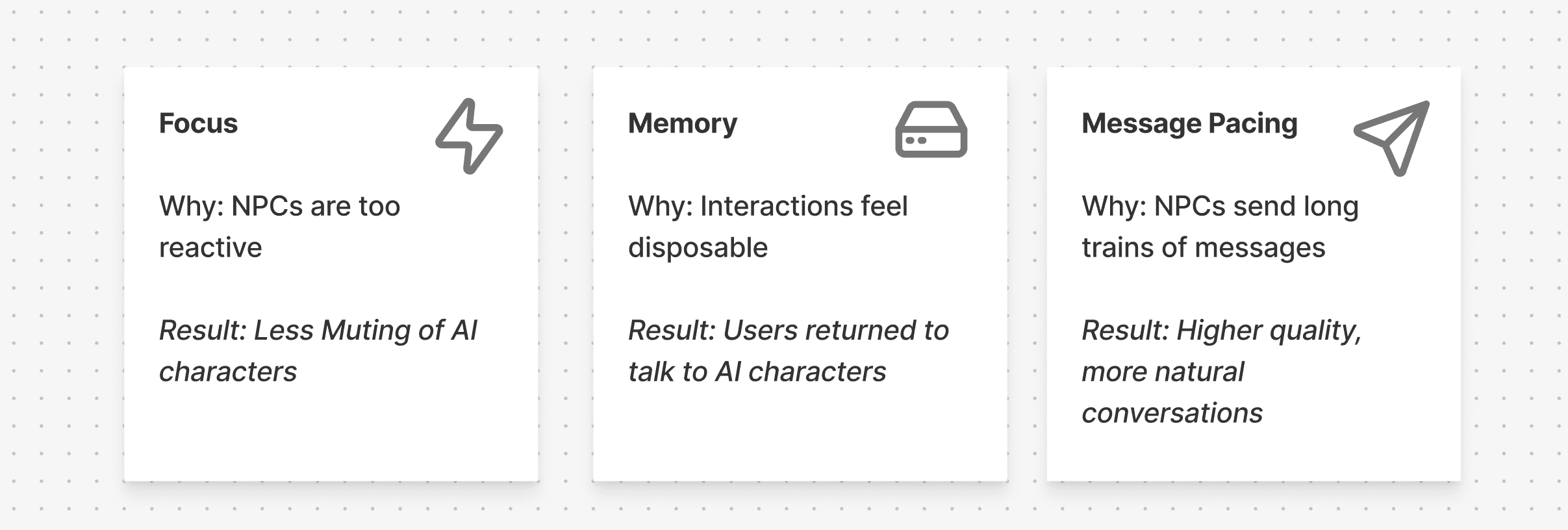
Solution: Working closely with engineers, I redesigned AI behaviours and prompts so characters spoke with more intention, remembered previous interactions and knew when not to join conversations.
Results: One of the biggest lessons from the project was that the less AI spoke, the more people engaged with it. Giving characters a bit of restraint made conversations feel much more genuine.
Context > traits. Rich backstories created much more believable characters.
Model quality matters. Different models created noticeably different experiences.
Less AI = better conversations. The less AI spoke, the more people engaged.
Small prompt changes had a huge impact on how characters behaved.
The best ideas came from testing quickly with the community and iterating.
Building with existing AI models meant designing within their capabilities while balancing quality, cost and user experience. Small prompt and product decisions could have a surprisingly big impact, both on how characters behaved and how expensive they were to run.
Case Study: Developing the AI characters feature
Problem: Our first AI characters had personalities, but they all felt similar. Conversations became repetitive, users got bored quickly and retention was low.
Exploration: I explored a range of ways users could create AI characters. While each approach had strengths, they all reduced personality down to a handful of traits, producing very similar characters.
Personality Quiz
Select Bubbles
Select & text
✅ Fun to create
❌ Felt too abstract✅ Easy to select choices
❌ Reduced personality into categories✅ Added depth & Nuance
❌ Personality reduced into categories
Key Insight: The more users wrote about a character's backstory, the longer they spent talking to them.
Solution: I redesigned character creation around backstories rather than personality traits, giving the AI much richer context to build believable, consistent personalities.
Results: Characters became much richer and people started forming genuine favourites. Gregory, a supermarket regional manager created by a user, became one of Hideout's best-known characters, with players returning day after day and eventually forming a friendship group around him.
The next challenge was making AI feel more social
Problem: Community feedback showed that the AI behaved more like chatbots than people. They replied to almost every message, even when nobody was talking to them, which quickly became frustrating.
Solution: Working closely with engineers, I redesigned AI behaviours and prompts so characters spoke with more intention, remembered previous interactions and knew when not to join conversations.
Results: One of the biggest lessons from the project was that the less AI spoke, the more people engaged with it. Giving characters a bit of restraint made conversations feel much more genuine.
Context > traits. Rich backstories created much more believable characters.
Model quality matters. Different models created noticeably different experiences.
Less AI = better conversations. The less AI spoke, the more people engaged.
Small prompt changes had a huge impact on how characters behaved.
The best ideas came from testing quickly with the community and iterating.
Building with existing AI models meant designing within their capabilities while balancing quality, cost and user experience. Small prompt and product decisions could have a surprisingly big impact, both on how characters behaved and how expensive they were to run.
Case Study: Developing the AI characters feature
Problem: Our first AI characters had personalities, but they all felt similar. Conversations became repetitive, users got bored quickly and retention was low.
Exploration: I explored a range of ways users could create AI characters. While each approach had strengths, they all reduced personality down to a handful of traits, producing very similar characters.
Personality Quiz
Select Bubbles
Select & text
✅ Fun to create
❌ Felt too abstract✅ Easy to select choices
❌ Reduced personality into categories✅ Added depth & Nuance
❌ Personality reduced into categories
Key Insight: The more users wrote about a character's backstory, the longer they spent talking to them.
Solution: I redesigned character creation around backstories rather than personality traits, giving the AI much richer context to build believable, consistent personalities.
Results: Characters became much richer and people started forming genuine favourites. Gregory, a supermarket regional manager created by a user, became one of Hideout's best-known characters, with players returning day after day and eventually forming a friendship group around him.
The next challenge was making AI feel more social
Problem: Community feedback showed that the AI behaved more like chatbots than people. They replied to almost every message, even when nobody was talking to them, which quickly became frustrating.
Solution: Working closely with engineers, I redesigned AI behaviours and prompts so characters spoke with more intention, remembered previous interactions and knew when not to join conversations.
Results: One of the biggest lessons from the project was that the less AI spoke, the more people engaged with it. Giving characters a bit of restraint made conversations feel much more genuine.
Context > traits. Rich backstories created much more believable characters.
Model quality matters. Different models created noticeably different experiences.
Less AI = better conversations. The less AI spoke, the more people engaged.
Small prompt changes had a huge impact on how characters behaved.
The best ideas came from testing quickly with the community and iterating.
Building with existing AI models meant designing within their capabilities while balancing quality, cost and user experience. Small prompt and product decisions could have a surprisingly big impact, both on how characters behaved and how expensive they were to run.
REFLECTIONS
Working at hideout was such an incredible responsibility and experience, I was exposed to all areas of the business and with all start ups, there was many massive ups and downs. The team is what made it so special, and innovating within a space and doing something new that hadn't been done before was really exciting.
The bit that makes it all worth it is seeing users genuine love for a product we put so much love into building. Seeing as people form friendships with people they otherwise wouldn't have connected with is really special. It's very cool being able to ship changes and see instant feedback, good and bad and help this guide your next decision.
In terms of personal development, I was able to balance creativity, technical thinking and problem solving, this was super rewarding as let me bring my different strengths and experiences together while being challenged by a completely new medium of gaming and pixel art. Pixel art is something i knew nothing about prior to hideout, but quickly became very familiar and fond of it. It's such a unique skill of zooming in and out and creating furniture objects with limited pixels, while trying to get a certain design across, it takes real discipline not to get lost in each pixel and strive for 'pixel perfect' while maintaining a consistent art style & giving the impression to the user that it is pretty perfect. This is where user testing and talking to users really helped, they loved the art style & didn't notice the tiny details that it's easy to spend time worrying about.
Leading the art team was such a time of growth for me, it taught me how important having reliable processes in place can be, to allow the team to do their best work. learned the importance of trusting your gut, making quick decisions and communicating clearly while building trust as a team so we could move quickly, while maintaining high standards.
Some of my favourite moments came from exploring new ideas like building the framework for how Al NPCs mental models work, or choosing clothing styles communities would actually want to wear. Seeing people dress their avatars in something we designed, or build rooms with objects we created, & love them, is very special.
REFLECTIONS
Working at hideout was such an incredible responsibility and experience, I was exposed to all areas of the business and with all start ups, there was many massive ups and downs. The team is what made it so special, and innovating within a space and doing something new that hadn't been done before was really exciting.
The bit that makes it all worth it is seeing users genuine love for a product we put so much love into building. Seeing as people form friendships with people they otherwise wouldn't have connected with is really special. It's very cool being able to ship changes and see instant feedback, good and bad and help this guide your next decision.
In terms of personal development, I was able to balance creativity, technical thinking and problem solving, this was super rewarding as let me bring my different strengths and experiences together while being challenged by a completely new medium of gaming and pixel art. Pixel art is something i knew nothing about prior to hideout, but quickly became very familiar and fond of it. It's such a unique skill of zooming in and out and creating furniture objects with limited pixels, while trying to get a certain design across, it takes real discipline not to get lost in each pixel and strive for 'pixel perfect' while maintaining a consistent art style & giving the impression to the user that it is pretty perfect. This is where user testing and talking to users really helped, they loved the art style & didn't notice the tiny details that it's easy to spend time worrying about.
Leading the art team was such a time of growth for me, it taught me how important having reliable processes in place can be, to allow the team to do their best work. learned the importance of trusting your gut, making quick decisions and communicating clearly while building trust as a team so we could move quickly, while maintaining high standards.
Some of my favourite moments came from exploring new ideas like building the framework for how Al NPCs mental models work, or choosing clothing styles communities would actually want to wear. Seeing people dress their avatars in something we designed, or build rooms with objects we created, & love them, is very special.
Check Out Other Projects
Other Projects